
Sequel review here! If you want to learn more about a fun, but perhaps not terribly deep, urban fantasy about a teacher of magic at a high school, see my review of Three Meant to Be. I was a little unsure of where I sat with Book 1. I enjoyed it certainly, but found it wasn’t quite giving me the depth or grittiness I was looking for in an adult magic school story, nor the sense of mystery from magic schools of my childhood, nor even the epic fight scenes of progression fantasy schools. About 50 pages into this book though, I shifted my brain fully into popcorn romance urban fantasy mode, and it really clicked. This series isn’t cracking my all time favorites, but I’m having a really wonderful time.
Read if Looking for: Magic School Teacher protagonist, escapist fantasy, bad puns, romance/fantasy elements balanced well
Avoid if Looking for: deep themes, unpredictable twists, realistic portrayals of teaching
Elevator Pitch:
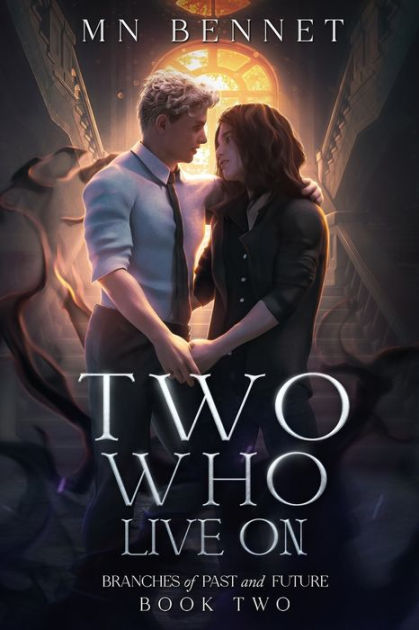
This book picks up right where book 1 left off. At the start of second semester, without the threat of one student being brutally murdered, Dorian is able to focus a bit more on himself and his relationship with his celebrity boyfriend (and childhood ex) Milo. He also needs to keep his students on track for a talent showcase, which might open doors for many of their future prospects. Of course, what would a semester of Dorian’s life be without the threat of constant demon attacks?
What Worked For Me
While this book isn’t a straightforward tropey romance, I really like the dynamic between Milo and Dorian. At first glance it’s a classic grumpy/sunshine pairing, and Dorian very much fits the mold of an archetypical grumpy romance narrator. He’s fun, but expected. Milo, however, is really the star of this book. His happy and exuberant personality is balanced by the fact that he’s manipulative out of a sense of benevolence. To a certain extent he can’t control the futures he sees, which will inevitably affect his decisions. However, he often leans into using powers to manipulate Dorian’s moods, just as Dorian is constantly linked to his mind with telepathy. The relationship isn’t a paragon of healthy boundaries, but I think it’s a much more realistic view of romances than we typically get, especially thinking about how a romantic relationships would be affected when both parties have slightly uncontrollable psychic powers. There’s enough overly idealized romances out there (which is great! I love them!) but this feels so refreshing to read, and the dynamics between them carry the book for me.
Otherwise, this is a book I turn my brain off for and enjoy. As soon as I stopped hunting for deep themes or nuanced takes on how classism manifests in private schools, it became a lot smoother of a read for me. This book was like a warm blanket: I knew what was coming, and was happy to go along.
What Didn’t Work For Me
My biggest complaint with the original book was the inauthenticity of the role of Dorian as teacher. It wasn’t bad, it just felt like every other workaholic teacher I’d ever seen. There was a little bit of work life balance in this story, but I would love to see Dorian be less idealized. Teachers make mistakes; we get grumpy, and we snap at kids when we’re having a bad day. Teachers are humans, and despite Dorian having ‘errors’ he feels a bit like a teacher robot who memorized textbooks on how to teach well. It’s a cool ideal, but typically not realistic in terms of the amount of time it takes outside of the work day to reach the level of teaching that always gets represented here and elsewhere.
Finally, I think the way the students are handled is a little bit clunky. 14 is simultaneously too many students to get deep characterization from any of them while simultaneously smaller than typical class sizes. In manga, large class sizes are typically handled by highlighted 1-3 students consistently as main characters. Aside from those few students, side characters typically fade entirely into the background or have a short arc where they become a main character in their own right before fading away. And while Bennet does pick a few students to get more attention (with suitably tragic backstories), he spreads his attention too evenly overall, meaning that all students are consistently on screen and mentioned, but never enough to go past anything but a caricature. It’s an approach that’s accurate to how teachers actually teach, but doesn’t lend itself well to storytelling.
In Conclusion: an enjoyable, if rather mindless, urban fantasy with a great central relationship but a poorly realized school setting.
- Characters: 4 (leads), 3 (students)
- Worldbuilding: 3
- Craft: 3
- Themes: 2
- Enjoyment: 4
 Marked for Plot