
I love a book with intricate worldbuilding, complex magic systems, and dynamic action scenes. However, I also love books that capture the mystery and magic of ancient religion, forgotten gods, and backwoods settings. House of the Rain King is plainly written, but doesn’t neatly slot into the storytelling styles of the current fantasy market. Its a great example of how indie and self publishing fills niches that mainstream books leave open.
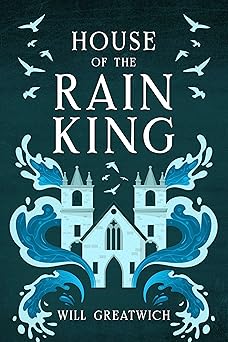
Read if Looking For: ancient magic, cruel gods, books that evoke Princess Mononoke, protagonists that happen to be queer
Avoid if Looking For: endings that clearly resolve all conflicts, compelling action scenes, mercenary companies that feel like mercenaries
Elevator Pitch:
The Rain House is a monastary in a very rural valley. They are the power center of the small community, and keep their land ready for the return of the Rain King. On the day an aspiring monk Emwort takes his initation rituals, The Rain King returns, bringing a flood to the valley that won’t end until he marries (and kills) a Bird Princess who sacrifices herself for the valley. He’s escorted by a company of soldiers hired to protect him, and whose two unofficial leaders vie for control. And an indentured servant is joyful that his debts since childhood will be wiped away with the flood, as the scripture says. The book explores the ancient mysteries of the town, haunted ruins, and a growing corruption amongst the elderly monks of Rain House.
What Worked For Me:
At some points, this book feels like a myth. The book is at its best when it lives in the unexplained gaps between folklore and history, of a senile god wandering a monastary and bringing flood and fear wheverever he visits. This book, more than so many stories with Dark Lords and invading armies, feels like a more honest exploration of the intersection of religion and rurality. The church is the center of the community, but what happens when God shows up. What should be a religious experience turns into an era of fear for the people who paid respect and honor to the god in his absence.
While I think many will feel frustration at the ending of the story, I quite liked it. To be frank, it didn’t resolve most of the problems put forward in the book. It’s unclear what the future of the valley is, what most of the characters futures look like, and without tidy resolutions to many character-arcs. It goes so counter to how authors typically end their books, but I think it reflects some of the core themes of the book. What happens when your faith is shattered, when your god turns out to be a monster? How the immediate aftermath of a natural disaster is devastation and hope, but with no real plan for how to return life to normal. How sometimes doing the right thing means losing everything you hold dear, and not knowing what’s on the other side of the reinvention to come. The start and end of this book committed to existing in that liminal space, and I loved it for that.
What Didn’t Work For Me:
I think the middle section of this book struggled a bit. The mystery and dreamlike quality of the opening (which returns to a certain extent at the end of the book), fell away for a fairly traditional style of storytelling. Characters going on adventures, uncovering mysteries, and advancing the plot in a fairly straightforward manner. While these plot threads did coalesce, I think I would have preferred had this story stripped away the multiple POV structure and focused most on Emwort, the new initiate at Rain House. His journey the thematic core of the book, but it ironically felt the least developed of the three main storylines (the new initiate, the mercenary company, and the indentured servant turned Indiana Jones).
Perhaps this feeling comes from how Greatwich was a competent plotter. All the storylines intersected in neat ways and slotted together like a puzzle, but I wanted him to commit to the messiness of the main storyline. The competency lead to predictability, as each plot progressed in jumps, instead of step by step. The biggest loss here was the monastic corruption plotline, which could have been an interesting examination of religious politics gone wrong, but ended up getting reduced to a single corrupt Abbott with a crowd of faceless monks at his back. It led to Emwort’s disollusionment with a religious order he idolized losing some of its power, which was really unfortunate.
Finally, while there was a lot to love with the mercenary company, but it felt artificially rigid. They hold to their contract terms with aggressive rigidity, even when it would lead to easily preventable deaths of their members. One of the two aspiring leaders of the company is even more rigid (which, along with some other parts of the story, lead a strong case for reading him as a character with autism), but it ended up feeling forced for the sake of manipulating plotlines. I think the book would have benfitted from simplifying the story to give more focus and development to one of the three storylines.
Conclusion: a creative and intriguing story about the power of religion in a rural community, though it tried to span a few too many plotlines to develop each fully
- Characters: 3
- Worldbuilding: 5
- Themes: 3
- Craft: 4
- Enjoyment: 3
 Marked for Plot