
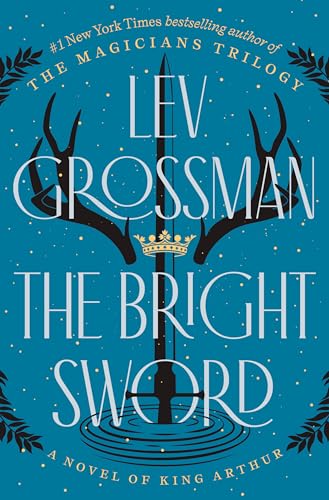
Lev Grossman hasn’t been my favorite author. The Magicians Trilogy didn’t resonate with me, and I found myself in a constant cycle of interest in the ideas he pursues but finding myself disengaged while reading. The Bright Sword generally continues that trend, where I can recognize that there’s lots to love in this interesting take on Arthurian myth, but one that I found myself skimming through. Full disclosure however, I read this book in the middle of packing to move, and probably would have benefitted from something lighter/more popcorny at that point in my life.
Read if Looking For: queer(ish) Arthurian tales, self-insert protagonists, sassy muslim immigrants, unknowable magic
Avoid if Looking For: consistent prose style, historically consistent worldbuilding, Arthurian writing featuring the classic characters
Elevator Pitch:
Collum is an aspiring Knight of the Round Table. He’s only got a stolen suit of armor to his name and a backful of scars from an abusive guardian. When he arrives, he finds Arthur is dead, Merlin is buried, and most of the accomplished knights missing, murdered, or maimed. He, Merlin’s traitor apprentice, and some of the lesser-known knights of the round table go on a quest (well, quests) to secure the future of their great country. Throughout this, we get quite a few backstory chapters for various characters, slipping back and forth between Collum’s present and his companions’ pasts.
What Worked For Me:
As someone who isn’t particularly knowledgeable or invested in Arthurian mythology, I really liked most of the backstory chapters. Each of the typically minor knights who got featured in this book usually had 2-4 backstory chapters for them alone. I found that these bits of the book had the tightest plotting, most engaging narrative voice, and deepest thematic work. Notably, the style of writing changed based on our viewpoint character in ways that really did a good job of cementing each of their personalities. Palomides in particular was a high point, with the sarcastic Muslim providing a delightful counter-vision of what Camelot and Britain were like. You laughed, you cried, you had deep and meaningful moments with fae at the bottom of a lake.
It’s worth noting here that the story isn’t at all concerned with historical accuracy. I recommend starting with Grossman’s Author’s Note at the end of the book, discussing how he is knowingly blending historical details from when Arthur would have lived (such as the strong influence of the fall of the Roman Empire on the story) with more medieval details (full plate armor, chivalric romance, blueberries), and how that connected to the way Arthurian myth itself was a hodgepodge of anachronisms that built over time. For me, this was interesting, but I anticipate it will upset many.
Another thing that will upset many is the queer representation! But I quite liked it. Notably we get reinterpretations of both gay and trans Round Table Knights, and I learned some bits and bobs about real trans historical figures. Overall I thought this representation was handled very well, and highlighted how including high-quality queer content in a book is entirely possible without it being a book primarily about queerness and without needing a queer lead.
Finally, I loved the magic of this world. As much as I am enjoying systems of magic with rules that are understandable, this book went hard in the opposite direction. It worked beautifully. We see lots of magic, but the book doesn’t even try to take the veil of mystery off it. The backstory chapters for Nimue (Merlin’s apprentice) in particular highlighted mystical-feeling magic at its finest.
What Didn’t Work For Me
Despite the rather long list of positives, I found myself utterly bored with Collum’s storyline. As interesting as the other knights were, I found him rather mind-numbing. He was a walking stereotype of a fantasy lead. Down on his luck history, rising to great heights, master with a sword, etc etc etc. Layer onto that a complete lack of personality or interesting engagement with plot moments, and I found myself skimming the ‘current’ events to get to the flashback chapters.
Unfortunately the modern plot, this was 2/3 of the book
The book salvaged itself near the end, with a rather delightful ending fight scene. Before that though, it into a trap of being one fetch quest after another, without any event mattering. And Collum’s characterization just wasn’t engaging enough, or the plotting tight enough, to justify a ‘went here, things happened’ story.
In Conclusion: An ambitious book that alternated between riveting and tiresome. Not totally sure what to think.
- Characters – 2 (Collum) or 5 (pretty much anyone else)
- Worldbuilding – 4
- Craft – 3
- Themes – 2
- Enjoyment – 3
 Marked for Plot