
Andrew Joseph White is an author who has done a great job of pushing the YA space in the last few years. Hell Follows With Us was good, but The Spirit Bares Its Teeth is a real masterpiece of a historical fiction horror. He has a habit of breaking away from the typical prose stylings and plot progression that has begun to feel very repetitive in modern YA Fantasy, feeling more akin to something we’d have seen in the early 2000s content wise, but with a lot more representation and modern sensibilities.
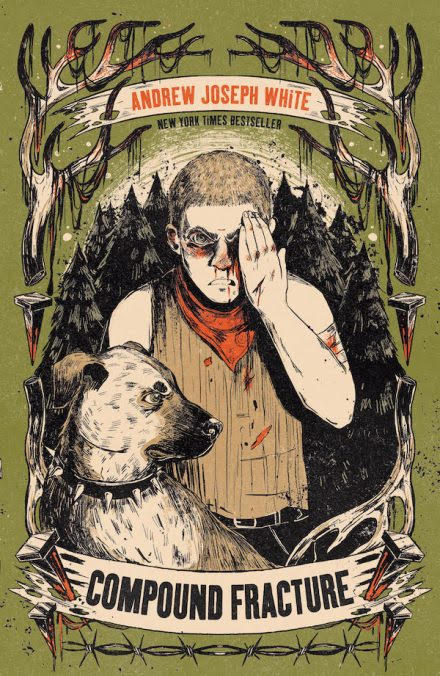
Compound Fracture is much more realistic than White’s other works (barely any speculative elements at all) and is heavily inspired by his own life and family. You’ll find most of his trademark elements (body horror, trans & autistic lead, religious queerphobia), and generally speaking if you like his other books you’ll enjoy Compound Fracture. In the end, I found this the weakest of White’s novels so far, but still very much enjoyed it.
Read if Looking For: gruesome descriptions of wounds, Appalachian culture, realistic queerphobia descriptions
Avoid if Looking For: lots of fantasy/supernatural elements, nuanced villains
Elevator Pitch
The Abernathys have a long and violent history with the Davis family. Going all the way back to union vs mining company wars, their history is a bloody one. Miles Abernathy has just come out to his parents as trans when he gets nearly killed via beating by sheriff’s son after showing a friend evidence of the Sheriff Davis’ corruption. Miles needs to navigate healing, his family’s poverty, and a desire for justice with the threat of more violence looming over his, and his family’s head. And all the while the ghost of his ancestor, Saint Abernathy, is haunting Miles, railroad spike piercing his mouth in death as it did at the end of his life.
What Worked For Me
As usual, trans and autism representation is done impeccably in White’s work. He nails the experience of coming out in a rural environment, how even good parents don’t always take the news well, and of some of the messiness of adolescent queerness. There’s a strong internal monologue, and Miles is a great viewpoint character to see the world through.
This book is also going to be phenomenal for those who like body horror. I didn’t find the looming dread of White’s other work to be as present, but you can expect plenty of bloody descriptions of bodies in various states of damage and carnage, along with a few animals. This isn’t my personal taste in horror, but its very well done.
Finally, this book is a great example of how to write an opening scenario. White sets up a bunch of dominos and tips them over immediately, leaving Miles to deal with a mess of plotlines to juggle throughout the book. Other authors could take note.
What Didn’t Work for Me
Ultimately, I felt like this book ended up being a tad too predictable. While there were some moments that surprised me (such as a really delightful conversation next to a half-skinned deer), I thought the book ended up doing too much foreshadowing, too much explaining, and not enough mood work. It was tough not to compare this story to The Woods All Black, another Appalachian horror book featuring a trans protagonist and a rural authority figure as the main source of horror. It just felt a little too … tidy, I guess? For all that I had to skip ahead of some of the sections of the audiobook because I couldn’t handle the gore, the plot itself and character dynamics just didn’t feel as natural or nuanced as I’m used to seeing from White. It was clear that characters (and the dog, especially the dog) were acting certain ways because that was how the plot arcs demanded they act, instead of as a natural progression of what we know about them already.
I think a good example of this was Miles’ journey towards seeing himself as aromantic. A lot of things were great, especially his internal monologue as he was having a ‘will I won’t I’ with his childhood friend Cooper. At one point though, he googles (unfortunately not an exact quote) “How do I know if I’m on the aromantic spectrum”. Ultimately, I feel like anyone who knows the term ‘aromantic spectrum’ is at least in touch with the idea of what it might mean, even if they don’t associate it with themselves yet. By comparison, I though Miles’ journey to discovering he was autistic to be much more natural and well-written.
In the end though, I think the biggest issue for me, especially in the back half of the story, was that I found Miles’ revenge story, and push for justice in town to be boring. I found that I was much more interested in Saint Abernathy’s story, of the brutal miner’s rebellion after their demands for better working conditions were meant with violence from the company. To be fair, however, this is entirely a matter of personal taste.
In Conclusion: a rural horror that was a bit too trite for my taste, especially compared to some of White’s other work.
- Characters – 3
- Worldbuilding – 4
- Craft – 3
- Themes – 3
- Enjoyment – 3
 Marked for Plot