
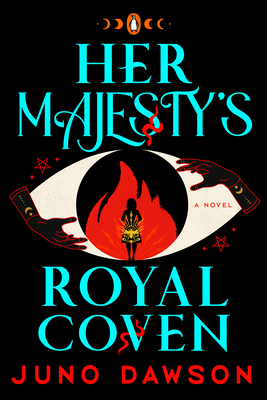
It’s been nice to see witches getting more love in fantasy over the last five years. Whether or not they delve into historical witchcraft or lean into fantasy cliches, they’re just a fun archetype. Her Majesty’s Royal Coven is a pretty damn good book focusing on what witchcraft in the modern age might look like. Like with a lot of modern fantasy, you’re getting some political commentary woven into the story, and this book does a good job of locking into an exciting plotline and sticking the landing.
Read if Looking For: witches, critiques of TERF ideology, witchy goodness, POVs from many ideological perspectives
Avoid if Looking For: Books with subtle themes, cinematic action
Elevator Pitch:
Her Majesty’s Royal Coven (HMRC) is a pseudo-governmental organization in the United Kingdoms managing the affairs of witches, keeping magic secret, and generally preserving traditions as well as they can. In theory of course. In reality, any group is political, and fracture lines have been spreading over the coven’s racist biases, especially post-civil war in the witch/warlock community. But when a young boy triggers the oracles saying the grand demon himself is rising, things will get rough quickly. Only he’s not a he. He’s actually a she. In this book we follow Helena (High Priestess of HMRC), Elle (a witch trying to live away from witchcraft as much as possible), Niamh (left HMRC to use her powers as a vet) and Leonie (who formed Diaspora, a coven focused on providing a community for witches of color) as they navigate their old friendships, current dilemmas, and what it means to be a woman.
What Worked for Me
I think this book did some interesting worldbuilding looking at how systems are the result of both history and human bias. HMRC is well-intentioned, and does a lot of good. but it has blinders on, which becomes apparent early and often. The book doesn’t rush to provide easy solutions to this – or any solutions really. It doesn’t seem like its trying to show how to make sweeping changes to organizations, but rather encourage a willingness to acknowledge and critique systems that don’t serve their purpose as well as they could, and to humanize (but not forgive) the people who are complicit in that process.
I found myself drawn most to Elle’s storyline. She uses illusions and memory wipes to keep her family from realizing she’s a witch, only to have it come back to haunt her when her daughter develops powers. Layer onto this the fact that she can’t keep wiping her husband’s mind without damaging it – and the fact that her friends know her husband is cheating on her but let it happen without telling Elle – and you’ve got a delightfully dysfunctional relationship primed to implode. And while I don’t think the narrative or characters we quite as willing to explore the ethics of memory wiping spouses (or memory wiping in general) as I would have liked, it kept me engaged.
I’ll also say that, despite a bit of a slow start, when the story started to pick up, I was definitely hooked. The final third of the story in general was paced wonderfully, and generally kept me hooked to my headphones. Always a good sign when an audiobook has me eager to sweep and unload the dishwasher.
What Didn’t Work for Me
While overall I found this book a really enjoyable read, I don’t ever quite think it reached its potential. It had the misfortune of coming shortly after I read The Sapling Cage (trans witch story) and Chain Gang All Stars (which used multiple perspectives as a way to explore and criticize the criminal justice system in America). And in the end, I found both of these outclassed Her Majesty’s Royal Coven in how Dawson tackled theme.
Sapling Cage centered the trans experience as the sole POV (while in this book we never get that perspective), and generally felt like a much more nuanced and interesting take on witchcraft, trans experiences, and it felt like, in this book, there were big missing pieces because we didn’t get Theo’s perspective on being trans. Considering how central of a plot point this was, I thought removing that perspective ultimately hurt the book, even if there was a level of tidiness to seeing where four friends ended up decades later.
Chain Gang All Stars, meanwhile, was a master-class in using characters with a wide variety of viewpoints on a topic to thoroughly critique and deconstruct a bigoted ideal. Helena and Elle both represent varied types of reinforcing anti-trans bigotry. Helena may not have a mustache, but the proverbial one gets twirled gratuitously . Especially near the end, it didn’t feel like there was much depth or nuance to her villainy. Elle is a doormat, willing to make excuses to keep things comfortable, even when comfortable really only applies to the people already in power – executed much more subtly and successfully. Unfortunately, I don’t think Dawson was able to differentiate the character’s narrative voices enough for this setup to be successful. Listening to the audiobook, it took me a long time to remember who the four leads were, which one was involved in specific plot points, and whose head I was in. That really can’t happen for a book with this setup to really shine.
These drawbacks didn’t stop me from enjoying the book. I quite liked it, especially in the final third. But I did mourn a bit for what could have been.
In Conclusion: a story with a lot of interesting ideas on systems-level problems, but lacked the depth and character differentiation to be truly great
- Characters – 3
- Worldbuilding – 3
- Craft – 4
- Themes – 3
- Enjoyment – 4
 Marked for Plot