
The intersection between Speculative Fiction and Westerns is something I’ve been interested in exploring for a while now. I’ve got both American Hippo and Make Me No Grave on my bookshelf right now, waiting for me to find the time to get around to them. This was my first foray into the genre, primarily because the Magical Realism elements were intriguing, as was the parallel storyline in the pitch.
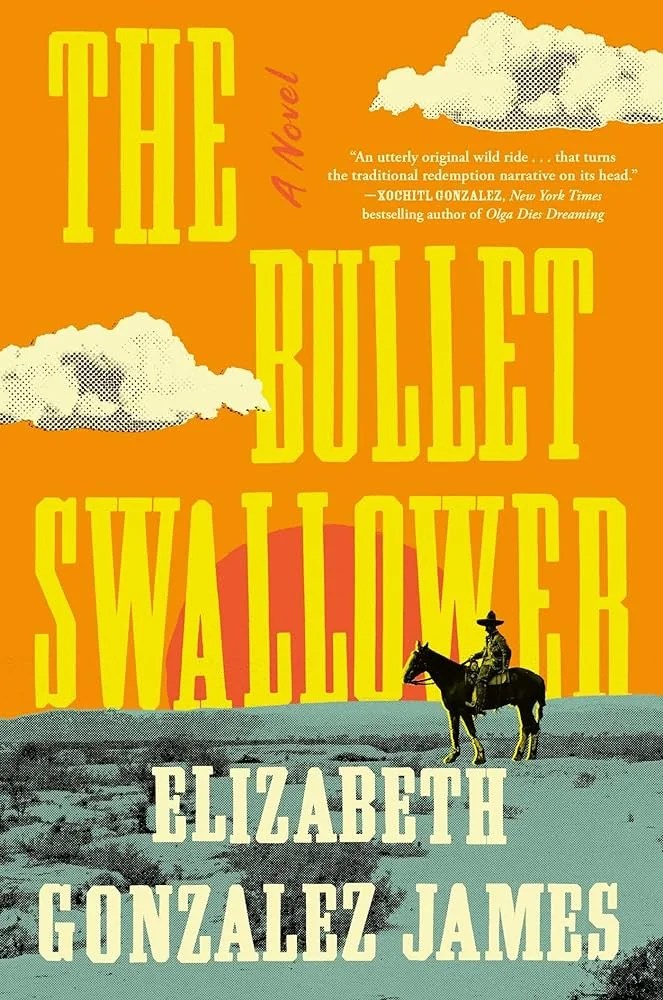
Read If Looking For: frank depictions of characters, family sagas, heaps of bravado
Avoid if Looking For: fast paced stories, lots of action scenes
Elevator Pitch:
The Bullet Swallower primarily follows the bandit Antonio Sonoro, the descendent of a long line of tyrants and despots. He’s chasing after the score to end all scores, but quickly ends up trapped in a cycle of survival, hunting, and being hunted. Seventy years later, Jaime Sonoro, a movie star, is gifted a book chronicling his family’s cruel history. And lingering above it all is Remedio, a being who knows the men are damned, and can do nothing to escape the twisted fate of the Sonoro family.
What Worked for Me
I thought that this book was extraordinarily successful in blending elements of Magical Realism with Westerns. It definitely leans more into the Western side of things, with big swaths of the story having almost no fantastic events at all. But it never vanishes entirely, and Remedio’s presence lingers over the story like a shadow. Even the focus on telling the story of a family over generations calls back to books like One Hundred Years of Solitude, giving this book a clear point of view.
I also really appreciated that this book centered the dynamics between Mexican citizens and Americans (especially law enforcement), including how that line gets blurrier and blurrier the more often Texas territory changed hands. It really succeeded as a historical novel in that respect as well, and isn’t something I’ve seen from my (admittedly quite limited) exposure to westerns.
It helps that the writing in this book is a tremendous plus. It finds a nice balance between brutally readable and waxing poetic. The prose was simple enough for me to follow along with the audiobook (the narrator did an excellent job) but had enough skill to build a really engaging portrait of two fascinating men. The author didn’t shy away from the brutality of life on the run. While there were moments of what one might expect following a bandit, there were also many that involved days of trudging through the drought-stricken countryside of Mexico and Texas, or grappling with the life left behind. Antonio’s actions feel natural extensions of who he is. He isn’t a ruthless monster as depicted, but neither is he a good, upstanding person. So often, stories centering criminals avoid nuance, but this book reveled in it.
What Didn’t Work for Me
In general, I found Antonio’s story much more engaging than Jaime’s. Part of it was that we spent more time with Antonio, but the author wasn’t able to find the same peaks and valley’s with Jaime. It was primarily an internal conflict storyline, but I don’t think it was as successful in execution as Antonio’s plot, which focused much more on external conflict. In a parallel storyline novel, one thread being weaker than the other dampens the impact of that narrative choice. The book sticks the landing, but a great ending to Jaime’s story wasn’t compensation for a lackluster first 2/3 of the book.
This was less a downside for me, but more an acknowledgement that for some, the lead bandit of the story is not going to be a fun character to read. He’s not particularly nice. And even if he is often acting out of a desire for revenge, or due to being framed for crimes he doesn’t actually commit, he’s not particularly ‘likable’ and isn’t someone you’d likely want to spend much time with in real life. He is still a bandit after all.
In Conclusion: If magical realism books focusing on bandits sounds like fun, this is a good option.
- Characters – 4
- Worldbuilding – 4
- Craft – 4
- Themes – 4
- Enjoyment – 4
 Marked for Plot