
I’ve got a great love for The Singing Hills Cycle, and picking up the newest release was a relatively easy decision for me. The series of novellas focuses on a historian cleric on various adventures, collecting the stories of the people and creatures of their world, which has clear Chinese and Mongolian influences. Storytelling, perspectives, and the meaning of truth are running motifs throughout the series, and they can be read in any order.
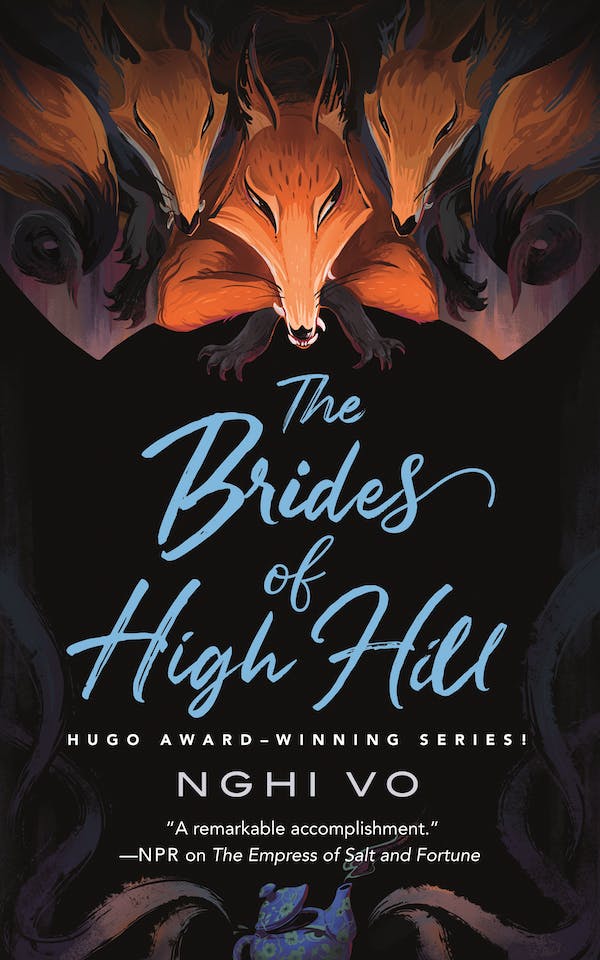
Read If Looking For: gothic horror, haunted houses, light mystery elements, quality prose
Avoid if Looking For: deeply thematic works, traditional fantasy storytelling
Elevator Pitch:
A historian cleric accompanies a young girl to her wedding, only to find that there is something dark going on in this house. The girl’s future husband has a mysterious past, the servants are tight lipped, and the cleric’s companion bird isn’t at their side to offer advice. And the cleric has a crush on the girl about to be married, and is desperate to save her from what they see as a potentially disastrous situation.
What Worked for Me
Nghi Vo continues to be a tour de force in how to write high impact stories with simple language. She understands how to create mood and atmosphere, characterize folks without overdoing it, and building a really compelling story in a short amount of time. This is definitely a more atmospheric piece than I’ve seen from this series in the past, and in some ways felt closer to some of her other writing. The manor house is dark, with characters wandering around at night, flirting with impropriety. The sense that something is wrong sort of hovers over you the entire time in classic haunted house (haunted manor) fashion. And while I felt like I knew where the story was headed pretty early, most I’ve seen write about it felt delightfully surprised at where things ended up.
This book also knew the right amount of ideas to tackle in a novella. Vo kept the story constrained, focused on scenes that would have high impact, and built up the story in layers that were thoughtful and meaningful. These constraints kept the story moving quickly without losing any of its punch, and in general novella writers can learn a lot from what Vo does.
What Didn’t Work for Me
My chief complaint with this book is that, while excellent, didn’t really feel like a Singing Hills Novella. This series, to me, is about thematic depth, varied perspectives, and looking at how simple things are actually more complicated than you’d have ever thought. The act of storytelling is important, including the method and format in which stories are told, and Chih (and by extension the reader) is oftentimes more of a witness than a participant.
This book lost a lot of that. Not only is Chih physically involved in the plot, the story lacked any real framing narrative, which I consider a hallmark of the series. There was some attention to theme in the last few pages, but in the end this book cared so much more about plot and vibes than anything else, that it just didn’t feel like it fit into the rest of the series.
In the end, I couldn’t help but wish this was a story in the same world, but featuring a different character who wasn’t a storytelling monk, because I think the mismatch between the expectations I have of the series and what this book was got in the way a little bit. If I remove that lens, I don’t really have any downsides to this book, but it’s hard to remove my emotions from one of my favorite series of all time.
In Conclusion: a foray into horror elements, this Singing Hills novella was excellent in isolation, but didn’t feel thematically or stylistically cohesive with the rest of the series it belongs to.
- Characters – 4
- Worldbuilding – 4
- Craft – 5
- Themes – 4
- Enjoyment – 4
 Marked for Plot