
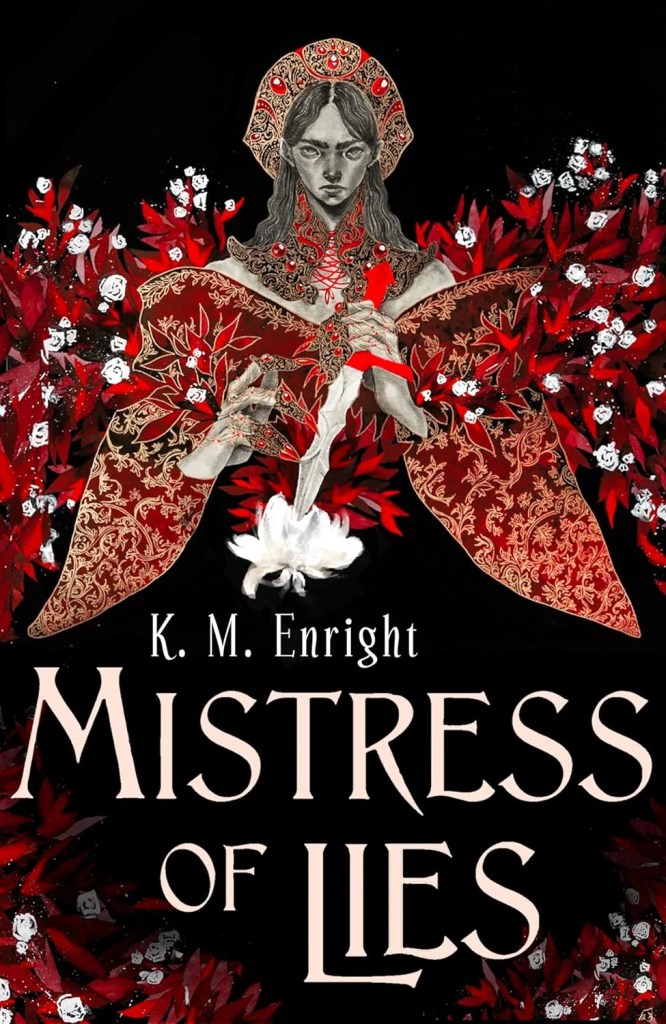
One of this year’s bingo squares is ‘Judge a Book by It’s Cover’ which challenges you to read a book without knowing anything other than what’s on the front cover. Mistress of Lies was my pick for my ‘published in 2024’ themed card. I thought the art was wonderfully evocative, and also visually distinct from a lot of cover art trends I’m seeing these days. Ella Garrett (designer) and Felix Abel Klaer (illustrator) did a phenomenal job.
Read If Looking For: romantic tension, polyamorous storylines, moral ambiguity
Avoid if Looking For: political intrigue, books free of YA/New Adult vibes
Elevator Pitch:
In a country ruled by an upper class of blood mages and led by a deathless king, a young noblewoman kills her father. She wants to change society for the betterment of her brother, who is Bloodless, and relies on scheming and plots to do so. Meanwhile, a Bloodless commoner stumbles upon a murder victim that has been causing discontentment amongst the Bloodless people, fostered by whispers of rebellion. He finds himself dragged into noble society against his will. And lingering around it all is the Royal Bloodworker, forming a trilogy of attraction as the three struggle to find an equilibrium in the newly unsettled Blood Worker Society.
What Worked for Me
The strengths of this book lie heavily in the realm of its romantasy elements. While it had a much more serious narrative style than what people think of when romantasy comes to mind, the way that Enright developed the three relationships between Shan (Young Noble Lady), Samuel (Commoner thrust into nobility), and Isaac (Royal Blood Worker) was excellent. They felt natural, alluring, and beautifully tense, and each of the three connections got the attention it deserved. There’s precious little of the over-the-top contrivances that romances often lean on to make stories work (which are delightful in their own right, but wouldn’t have worked for this story). While polyamory and female POV romances aren’t my cup of tea, the romance (and the few sex scenes we got) were still quite enjoyable. I think it really sung in this respect, and is a great pick for romantasy for those who might not like the tone of romances.
I also think the book does a great job of presenting a classic modern dystopia storyline that, while technically predictable in its plot beats, doesn’t feel as tired as many these days do. It isn’t going to win any awards for originality on the plot-structure front, but I think it was executed in a way that was fun and engaging. I especially enjoyed that the book is pushing towards themes (hopefully developed more in sequels) of the pros and cons of different ways of trying to reform/reforge/tear down/etc a corrupt system. I often found myself disagreeing with the POV characters on the morality of various character’s actions, and I think the narrative encourages readers to question their conclusions, especially Shan’s.
What Didn’t Work for Me
The biggest downside for me was that I felt like the political elements of this story didn’t really come together as well as I wanted it to. The story keeps telling you that political maneuvering is happening and is important to the plot. Shan is the titular Mistress of Lies, manipulating those around her through parties and social calendar invitations and her secret network of spies. But I never really felt like any political elements were developed past the surface level. The book would have benefited from a deeper focus on this, especially since it would have given a lot more nuance to the dystopian elements of the story. And the political storyline was a big enough portion of the story that I think, despite it being my only major gripe with the book, it’s a pretty significant one.
In Conclusion: A vampire-adjacent dystopian romantasy featuring great romantic tension, but I wish had more political depth to it.
- Characters – 4
- Worldbuilding – 3
- Craft – 3
- Themes – 4
- Enjoyment – 3
 Marked for Plot