
Tarot Readings and Psychics have never really been my thing. I like the idea of them, the layers of meaning in the cards over time and how they represent core aspects of the human experience. However, I don’t particularly subscribe to the more supernatural aspects of them in real life. In Fantasy however, I find them a delight. And my favorite thing about The Mask of Mirrors (and its sequels) is that the in-universe Tarot analogue, aside from being wonderfully designed, was used by the authors as part of the writing process. Every card reading in the story – with one notable exception – was done in real time in our physical world, and the results were the ones used in-universe, helping to drive narrative beats and character arcs. It shouldn’t work, but M.A. Carrick show their writing chops by turning what could be a disaster, into a really excellently crafted trilogy.
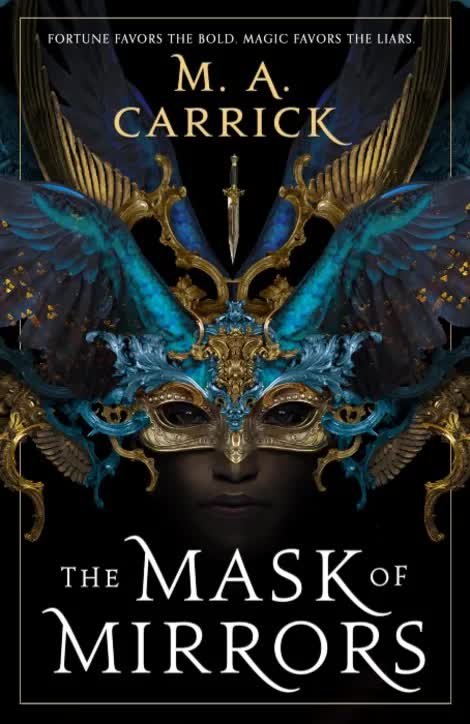
Read If Looking For: deeply realized cultures and characters, con artists, lavish descriptions of clothing, queernorm worlds
Avoid if Looking For: a fast paced story, or one that prioritizes action scenes
Elevator Pitch:
Ren has returned to her home city of Nadežra years after fleeing the criminal gang that raised her. With the help of her sister, she hopes to get herself adopted into a noble household by masquerading as a long-lost niece and make off with their fortunes. Unfortunately, the family turns out to be nearly destitute after a perhaps supernatural string of bad luck, the city’s cultural tensions are about to boil over, and Ren’s past debts to the underworld come knocking.
What Worked for Me
First and foremost, I want to credit their authors for their work with the city of Nadežra. Most authors in fantasy build wide, giving large-scale histories priority to create a sense of grand expansiveness. M.A. Carrick instead went deep into a single city. Both authors are anthropologists, and it shows in how this book was written. Nadežra is a colonized city, and home to a sacred religious location for city’s original inhabitants. The tension between both cultures is tangible, and enhanced by the level of detail paid to both groups. Beyond the normal affectations of culture that authors normally go for, M.A. Carrick delved into building a convincing pair of societies (and those who belong to both) through language, modes of respect, understandings of time, cultural values, and, of course, clothes. If you’re at all a hobbyist in fiber arts, this is an excellent series to look at, because the authors went all out on clothing in particular, and it was a joy to read lavish depictions about the different outfits, how they would be read by various parties, and how pattern-making was a powerful tool in a seamstress’s belt. I digress. The bottom line is that the city of Nadežra is complex, layered, and unlike anything I’ve seen in the fantasy genre.
From a plotting and character writing perspective, this book is a great example of what slow burn writing can look like. The con-job’s progress and Ren’s underworld past are explored in wonderful detail, with Ren being forced to code switch between two identities as the story shifts. And as the pressure and stress she’s under grows, you start to see the cracks in the masks she wears begin to widen. From the way she reacts to unexpected situations to the dialect she’s speaks in, you can tell her mental state from the writing, instead of needing to be told every single detail. The book revels in detail, which lead to read where I often walked away from the story for a few days to find something a bit punchier, but I was drawn back over and over again.
Finally, I want to credit queer representation in this work. The lead is a straight, cis woman, but the wider cast and world is wonderfully queer. It’s a great example of what queernorm worlds look like. Ranging from casual references to trans identities through Nadežra’s cultural lens to families being formed through choice instead of blood, the book feels utterly queer despite our lead not being queer at all. This does shift a bit in books 2-3, when a bisexual aromantic man becomes a central POV character.
What Didn’t Work for Me
There were a few reveals that felt really well earned, but then there were a couple that I thought came out of nowhere and didn’t feel built up enough. It’s also the type of book that I grew to enjoy more the further I got from it, taking it from ‘good’ to ‘great’ in my mind. It’s one I definitely want to reread to see how it holds up.
In Conclusion: A con artist returns home in a delightfully indulgent story about identity, family, and culture.
- Characters – 5
- Worldbuilding – 5
- Craft – 4
- Themes – 4
- Enjoyment – 4
 Marked for Plot
One thought on “The Mask of Mirrors”