
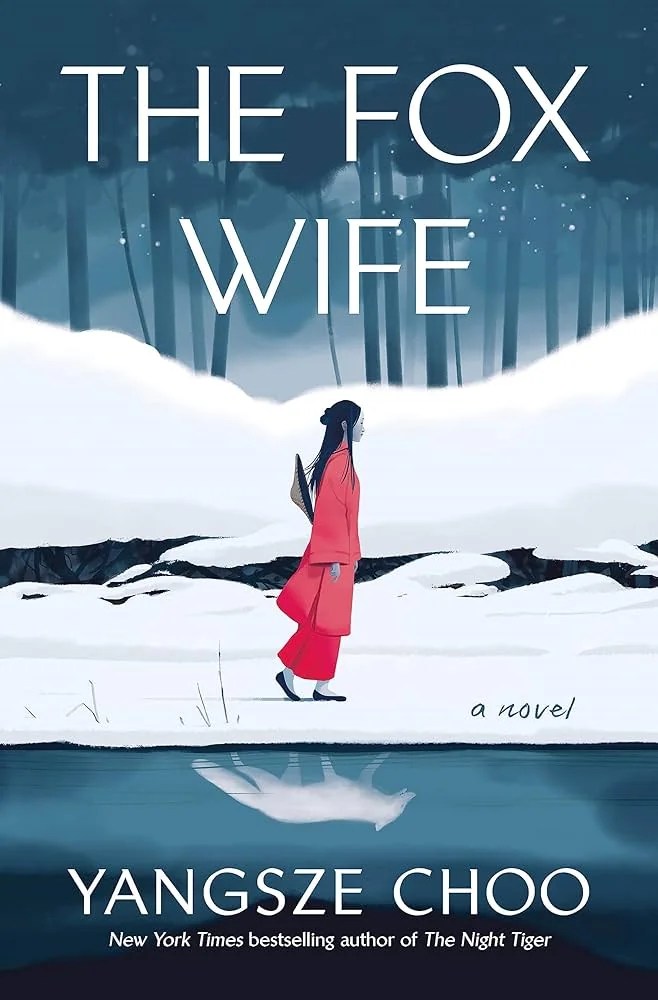
Historical Fantasy isn’t my go-to subgenre, but The Fox Wife grabbed my attention from the cover art and a plot summary that had me intrigued. Foxes have been a running theme of my reading for around a year, with them popping up in expected and unexpected places, so it felt apt from a motif standpoint as well.
Read If Looking For: atmospheric books, Chinese and Japanese historical settings, few fantastic elements, charismatic characters, feminist themes
Avoid if Looking For: tightly-written mysteries, political intrigue, or action scenes
Elevator Pitch:
The Fox Wife shifts between two lead characters in 1908 East-Asia (mostly various parts China). Snow is a Fox, one of the shapeshifting tricksters who has lived centuries and goes by many names. Bao is an investigator with a supernatural gift for discerning truth from lies. Snow seeks revenge for her dead child and finds herself attached as a servant to a family living under a curse. Bao has been hired to investigate a the identity of a dead courtesan. Their journeys bring them into contact with their pasts and with other foxes who have agendas of their own.
What Worked for Me
The big selling point for this book are the two leads. Both Snow and Bao are strong voices, who present very different viewpoints on the story. Snow (first person chapters) is whimsical, quick to jump into action, and constantly pushing the story forward. Bao (third person chapters) is slower paced. He’s reflective, methodical, and constantly dwelling on his past as he enters the final stages of his life. I think Snow is probably the more gripping of the two immediately, but Bao is what kept the story grounded, providing more of the emotional support that the book needed. There’s a version of the story where Snow is our only narrator, but I think the book would have been worse off without it.
Most of the side characters are similarly well-realized. The other foxes we encounter and hear about (many as only passing mentions) paint a picture of a charismatic folk. Choo does a great job of capturing their magnetism, the unnatural pull they have on others, and how quickly that can backfire on them. Their capriciousness lends itself well to a story that is otherwise quite contemplative.
As an aside, this book isn’t one that you’ll enjoy if you’re looking for constant action, tangled political intrigues, or mighty displays of power by the Foxes. It’s a book that doesn’t even provide answers to all of the plot points once the book ends. If you’re looking for something traditional in terms of story structure, this isn’t the book for you. Even the epilogue touches on this, how this was but one snippet of the stories of the characters. It chose to hew closer to what we might consider in a realistic fiction or historical fiction in terms of style, and it was a choice that I think worked really well for the story. It wasn’t a loud book, but it was a good one.
What Didn’t Work for Me
I think perhaps my chief complaint is that the Foxes, while wonderful, didn’t end up quite as fox-like as I would have liked them to be. They are only ever in fox form in flashbacks, spending the entirety of books in their human selves. A reasoning for this is provided, but it still felt like a bit of a missed opportunity. In the end, the characters could largely have been transported over into a different setting, labeled as incubus/succubus type characters who have the same sort of charismatic pull on others, and not a lot of would have been lost story-wise. I don’t think it was bad, but it was a bit disappointing.
There was also some slight miscommunication tropes around an old romance that felt out of place and frustrating in a book that was otherwise one that avoided this kitschiness. Thankfully it was fairly minor, and not particularly relevant to the plot. Still, it’s worth noting.
In Conclusion: The Fox Wife is a great option if you’re open to a slower read that deprioritizes plot in favor of interesting characters. Does a particularly good job of presenting the charismatic foxes as a supernatural entity.
- Characters – 4
- Worldbuilding – 5
- Craft – 4
- Themes – 4
- Enjoyment – 4
 Marked for Plot